

Canadian trade tension yields negative reactions
The inability of negotiators from the United States and Canada to reach agreement on trade terms that would have reduced tariff activity has prompted statements of concern from several trade groups with ties to the recycling industry.
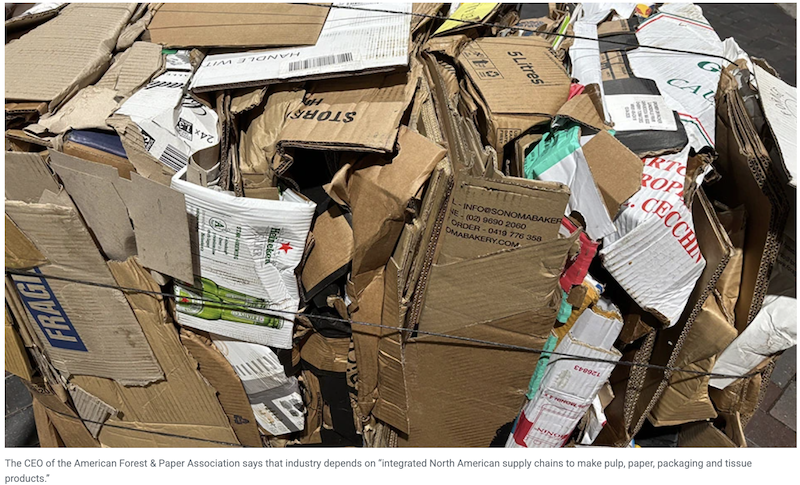
Either before or after negotiations broke down, two Washington area trade groups, the American Forest & Paper Association (AF&PA) and the Glass Packaging Institute (GPI), have issued statements urging negotiators to return to the table.
“At a time when our industry is competing against unfair global trade practices, nonmarket economies and evidence of potential excess capacity from places like China, it is important for the U.S. to continue to strengthen North American competitiveness and preserve the supply chain certainty companies need to make long-term investment decisions in U.S. mills, equipment and workers,” says AF&PA President and CEO Heidi Brock in a late July statement.
“AF&PA has supported the [Donald Trump] administration’s strong actions to defend U.S. manufacturers from unfair trade practices and strengthen domestic production,” Brock writes.
“However, broad tariffs on Canadian inputs could create real disruptions and uncertainty for industries like ours, which depend on integrated North American supply chains to make pulp, paper, packaging and tissue products. Those same supply chains also support hundreds of thousands of jobs in communities across the U.S.”
The supply chains Brock mentions include considerable volumes of recovered paper.
This week, after negotiations broke down and both nations announced or threatened additional tariffs, the GPI issued a statement reading in part, “As an active member of the Toasts Not Tariffs Coalition, the GPI joins the coalition in calling for a swift resolution to the U.S.-Canada trade dispute and the return of U.S. wine and spirits to Canadian store shelves.”
Regarding cross-border trade in glass jars and bottles, many made with recycled content, GPI states it is “particularly concerned about the additional impact of the 50 percent Section 338 tariff on Canadian glass bottles and jars and other raw materials used in glass industry and the increased pressure it could place on an already highly integrated North American supply chain that has seen sales declines during the reciprocal tariff policy debate.”
The group concludes, “GPI urges officials in both countries to swiftly resume negotiations and reach a resolution that restores market access for U.S. wine and spirits, and Canadian wine and spirits, protecting the North American glass supply chain and returns to the mutual benefits of tariff-free trade under the U.S.-Mexico-Canada Agreement (USMCA).”
Two other associations, one tied to the heavy equipment sector that supplies machinery to recycling plants and another that represents a cross-spectrum of American manufacturers, also have urged the Trump administration and Canada’s government to restart negotiations.
Brian P. McGuire, president and CEO of the Illinois-based Associated Equipment Dealers (AED), says, “AED has always had a stance supporting free and fair trade in North America as the best means for achieving economic prosperity and growth in the sectors our members serve. Tariffs and retaliatory tariffs damage the economies on both sides of the border.”
McGuire adds, “Any measures that target equipment that builds, feeds and fuels both countries are detrimental regardless of if they're imposed by Canada or the U.S. AED will continue to work with officials and political leaders on both sides of the border to encourage a return to the bargaining table.”
In mid-August, before negotiations had collapsed, the Washington-based National Association of Manufacturers (NAM) posted excerpts from a podcast conversation between its Vice President of International Policy Andrea Durkin and a podcast hosted by advisory firm Grant Thornton.
“We export one-third of all U.S. manufactured goods to Canada and Mexico,” Durkin says on the podcast. “That is more than to the next nine U.S. manufacturing export partners combined, and since implementation of USMCA, 15 of 18 manufacturing subsectors have increased their exports to Canada and Mexico, and they’re growing faster than to other markets.”
U.S. tariffs on Canadian goods, including the latest round of Section 338 tariffs, largely have been developed and established by the Trump administration without the approval of the U.S. Senate, which traditionally has played a role in tariff enactment.
Early this week, ABC News reported negative reactions from several senators, including Republicans who comprise the chamber’s majority, to the lack of progress in Canadian trade talks.
However, none of the senators quoted in the story refer to authored legislation or other moves within the legislative body to roll back or modify any Trump administration tariffs.
This article was originally published in Recycling Today.